


Fitness for High-Performing Tech Professionals: A Different Approach

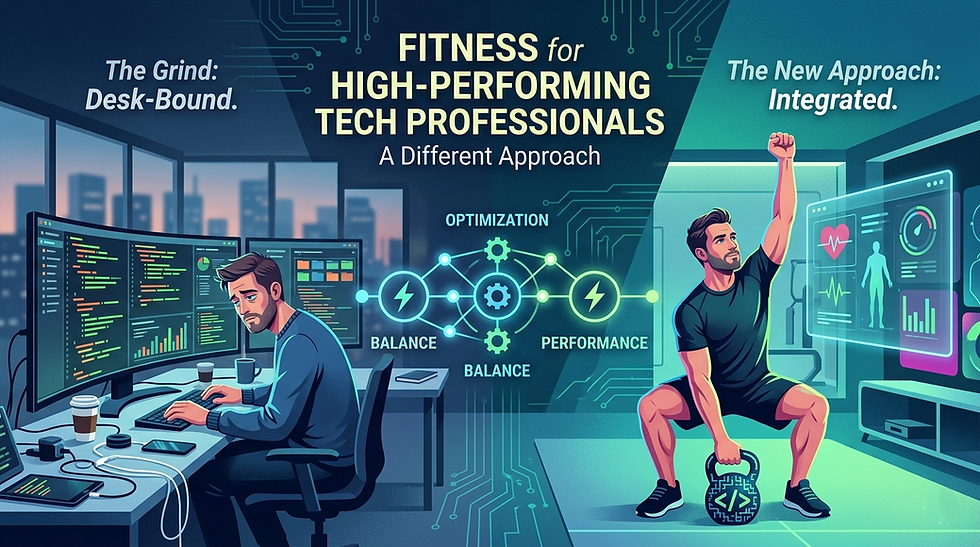
Most fitness advice is written for people with predictable schedules, moderate stress, and a straightforward relationship with their body.
That's not a software engineer. That's not a tech lead. That's not a founder running a company while trying to maintain some version of a healthy life.
The people I work with are high performers in a specific way - not gym high performers, but cognitively demanding, chronically overstimulated, perpetually connected professionals whose relationship with their body has been shaped by years of prioritizing everything else.
They're not lazy. They're not unmotivated. They've tried the standard advice and found that it doesn't fit the life they're actually living.
This is what a different approach looks like.
Why Tech Professionals Are a Different Population
The standard fitness model assumes that the primary challenge is motivation - getting someone to show up and do the work.
For most software engineers and tech professionals, motivation isn't the problem.
Execution under real constraints is.
The constraints are specific.
An irregular schedule that makes consistent training windows difficult to protect.
A cognitive load so high by the end of the working day that decision-making around food and exercise is genuinely impaired.
A stress response that runs continuously rather than episodically, which affects recovery, sleep, hormones, and body composition in ways that generic programs don't account for.
A relationship with optimization and systems thinking that can turn fitness into another productivity project - and then another source of failure when the project gets deprioritized.
Add to this the physical specifics of the work: ten hours a day at a desk, a forward head position from screen work, hip flexors shortened from chronic sitting, a posterior chain that barely fires, and a nervous system that never fully switches off because the work lives inside the same brain that's supposed to be resting.
This is not the population that standard fitness advice was designed for. And applying standard fitness advice to this population produces predictable results: a good start, a period of inconsistency when work gets demanding, a restart, another collapse, and eventually the quiet conclusion that fitness just isn't compatible with this career.
It is compatible. But it requires a different approach.
The Stress Is the Variable Nobody Accounts For

The most important concept for understanding fitness in tech is one that most fitness programs ignore entirely: the body doesn't distinguish between sources of stress.
A brutal training session, a difficult product launch, three nights of broken sleep, and an emotionally demanding week at work all draw from the same recovery pool.
The gym program designed for someone with moderate life stress and eight hours of sleep will produce overtraining and fatigue in someone carrying the cognitive and emotional load of a senior technical role or a growing company.
This isn't an excuse to train less. It's a reason to train smarter - to account for total stress load when deciding how hard to push, and to understand that a week where everything went wrong at work is a week where the training needs to adapt, not maintain its scheduled intensity regardless.
I track my own recovery with a Whoop.
The pattern it shows isn't just about sleep. It reflects the cumulative load of everything - training, work stress, sleep quality, cognitive demands, personal responsibilities. On days where recovery is low, pushing hard in the gym produces fatigue, not adaptation. On days where recovery is high, the same session produces progress. The difference isn't effort. It's timing.
Tech professionals who learn to read their own recovery - whether through data or through the physical signals the body sends when you learn to listen to them - train more effectively with less volume than those who follow a rigid program regardless of state.
What Actually Works: The Minimum Effective Dose
The goal for most tech professionals isn't to become competitive athletes. It's to maintain a body that supports a demanding career, feels good to live in, and doesn't become a source of additional problems on top of an already demanding life.
That goal is achievable with less than most people think.
Two to three resistance training sessions per week, thirty to forty-five minutes each, built around compound movements - squat, hinge, push, pull - with progressive overload as the organizing principle.
This is sufficient for meaningful improvements in strength, muscle mass, body composition, and the metabolic health markers that matter for long-term performance.
It's not sufficient if the sessions are random, inconsistent, or executed without progressive intent. Consistency and progression matter more than volume. Two well-executed sessions every week for a year produce dramatically better results than four sessions for six weeks followed by a two-month gap.
Nutrition for this population is less about optimization and more about structure.
The engineers and founders I work with don't fail at nutrition because they don't know what to eat. They fail because the decision-making infrastructure around food collapses under cognitive load. The fix is environmental and structural - pre-decided meals, protein at every sitting, a ready option available when willpower is depleted - not more information about macronutrients.
Sleep is the most underestimated performance variable in tech. Not just for fitness but for everything. The cognitive output, creative problem-solving, emotional regulation, and decision-making quality that tech professionals depend on are all directly degraded by insufficient sleep. Treating sleep as what happens after everything else is done is treating the most important recovery mechanism as optional.
The Specific Challenges
Over years of working with software engineers, developers, team leads, and tech founders, the same challenges come up repeatedly. They're worth naming directly.
The afternoon energy crash that derails the second half of the workday - driven by blood sugar instability, prolonged sitting, and the accumulated cognitive load of the morning. Movement and meal timing address this more effectively than caffeine.
The weekend nutrition collapse that undoes five days of reasonable eating - not a discipline failure but a structure failure, because the external scaffolding that organizes weekday eating disappears on Saturday morning and the cognitive resources to replace it with conscious decision-making are depleted.
The posture deterioration that produces chronic neck tension, upper back tightness, and lower back pain after years of desk work - driven by muscle imbalances that pulling movements in the gym address more effectively than any amount of reminding yourself to sit up straight.
The inability to switch off after work - the open loops in working memory, the cortisol that stays elevated into the evening, the default mode network processing work problems during supposedly restful time - that prevents the genuine recovery the next day's performance depends on.
The muscle loss that happens so gradually after thirty that most engineers don't notice it until the consequences are obvious - driven by reduced physical demand, disrupted hormones, and the progressive replacement of active time with sedentary time as careers advance and responsibilities increase.
Each of these is a solvable problem. None of them are solved by standard fitness advice.
The Philosophy
The approach I use with tech professionals isn't complicated, but it rests on a few principles that differ from mainstream fitness culture.
Consistency beats intensity. A sustainable two-session week maintained for two years produces better results than an aggressive five-session program maintained for six weeks. The question to ask about any fitness approach is not whether it's optimal but whether it's executable within the actual life being lived.
Recovery is half the program. The training stimulus creates the conditions for adaptation. The recovery is where the adaptation actually happens. For tech professionals carrying high cognitive and emotional loads, the recovery side of the equation requires as much attention as the training side.
The body is not a separate project. It's the physical substrate of everything else - the work, the decisions, the relationships, the capacity to do hard things over a long period. Treating fitness as a productivity optimization misses this. The goal isn't a more efficient body. It's a life that includes physical health as a non-negotiable component rather than a recurring project that keeps getting deprioritized.
Physical capability matters in the AI era specifically because so much of professional value is migrating to cognitive and creative domains that machines can replicate. The things that remain distinctly human - physical presence, embodied experience, the capacity for genuine rest and genuine effort - become more important, not less, as the cognitive parts of the work get automated.
Taking care of the body isn't a retreat from a demanding career. For high performers in tech, it's one of the few remaining competitive advantages that can't be outsourced.
I work 1:1 with software engineers, developers, and tech professionals who want a fitness system built around the actual demands of their career. One monthly call, async support, a program that fits your life. Book a free 30-minute call and let's talk about what that looks like.


Comments