


I was the skinny kid who couldn't find clothes that fit.

Growing up in Plovdiv, I was that guy.
The one who wore three layers in summer because nothing hung right on his frame.
The one who avoided mirrors. At some point, I decided I was done being defined by that - and I walked into the most serious gym in Plovdiv at the time.
That decision changed everything.
The gym that built me
The place I found wasn't a commercial gym with treadmills and pop music.
It was the kind of gym where characters get forged.
Where the bar doesn't move until you're ready, and the people around you don't let you quit.
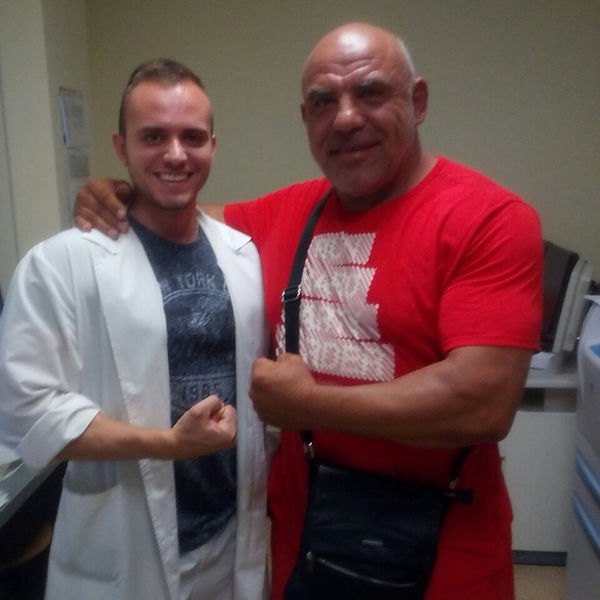
There I met my mentor, Georgi Manavski.
He didn't just teach me how to train.
He taught me how to be a man.
How to show up.
How to handle pain, pressure, and failure without falling apart.
That gym, and that man, shaped everything that came after.
I started in 8th grade. I haven't stopped since.

The numbers, and then the injury
By 18, training had become something serious.
I was competing in powerlifting and placing top 3 in the men's category with a 260kg squat, 195kg bench press, and 260kg deadlift at 83kg bodyweight.
Then I tore my hamstring.
For someone whose entire identity had become wrapped up in competing, that injury was a hard stop.
I had to sit with it - literally and figuratively - and rebuild my priorities from scratch. I kept competing in bench press events for a while, because I wasn't ready to let go completely.
But I knew something had to change.
Night shifts, medical college, and figuring it out alone

While recovering, I enrolled in medical college and worked night shifts as a security guard to pay for it myself.
No financial support, no shortcuts. The medical education gave me a foundation in how the human body actually works - not the bro-science version, the real one.
Training never fully left, even in those years.
Reduced, modified, squeezed into whatever gaps the schedule allowed - but always there.
Berlin. 250 euros and a dorm room

I met my wife when she was preparing to leave for Berlin to study at HTW. Two years of a long-distance relationship later, I packed everything and followed her.
I arrived with 250 euros.
That covered two months of public transport cards and two grocery runs at Lidl.
That was it.
I had no work documents. No German.

We were sleeping in her student dorm room, which was only permitted for her - nobody could know I was there.
I paid for a German language course myself and failed it three times before passing.
I worked whatever jobs I could find.
Through all of it - reduced, adapted, sometimes barely - I kept training.
Eventually I got a job at Charité Campus Benjamin Franklin, Berlin without fully approved documents and some compromises on the pay. After a year and a half I knew it wasn't where I was going. I decided to make my passion my profession.
Alex Powerbuilding - born in a pandemic
I enrolled in an intensive certification course in Berlin.
Two months in, every gym in the world closed.
That was my launch.
I got certified as a personal trainer and nutritionist through OTL Berlin.
I started coaching clients in our living room.
No gym, no equipment room, just programming, accountability, and results.
The clients who could afford online coaching at the time were mostly tech professionals - software engineers and developers who worked remotely and had disposable income but no time.
That accident of circumstance became my niche.
Leaving again. This time for good.
After things settled post-pandemic, we got married.
And we made another decision that most people thought was insane: we left Berlin entirely and moved to a small village in the Rhodope mountains in Bulgaria. 300 residents.
A rented house we'd never seen before. No safety net.
We built from scratch again.
I applied the marketing, sales, and business knowledge I'd built over years in Berlin and landed a role at Logifleet - a Swiss technology company - as a remote marketing professional.
We became parents. I kept coaching. I kept training.
Today I balance a full-time remote job, 1:1 coaching clients, a family, and my own training.
Leaving again. This time for good.
I'm not a coach who read about discipline in a book. I've had to rebuild multiple times - in a foreign country, with no language, no money, no network, no fallback.
I've trained through injury, night shifts, a pandemic, and two major life relocations.
I know what it means to keep going when the conditions are terrible.
My clients are software engineers, developers, team leads, and entrepreneurs.
People who are sharp, driven, and genuinely time-poor.
People who've tried the generic programs and found they don't hold up against a sprint, a product launch, or a twelve-hour debugging session.
I coach them because I understand the specific weight of a cognitive-heavy life - the fatigue that doesn't feel like normal tiredness, the difficulty switching off, the way stress accumulates differently when your job lives entirely in your head.
Everything I've built - the certifications, the years, the failures, the relocations - gives me a perspective that's hard to fake.
If any of this resonates, let's talk.Book a free 30-minute call. No pitch, no pressure - just an honest conversation about where you are and whether I can help.