


Burnout or Overtraining? Why Software Engineers Can't Tell the Difference (And Why It Matters)


You've been exhausted for weeks. Motivation is gone. Sleep doesn't restore you.
The gym sessions that used to help feel like another item on a list you can't get through.
Everyone around you says it's burnout. You've read the articles. You've nodded along to the symptoms. Maybe you've even taken a week off and come back feeling exactly the same.
But what if the diagnosis is wrong?
Software engineers are uniquely positioned to confuse burnout with overtraining - and to treat the wrong problem for months while wondering why nothing improves. Understanding the difference isn't academic. It changes everything about what you do next.
The symptoms are almost identical - and that's the problem
Burnout and overtraining share a symptom profile that would fool most doctors, let alone most engineers trying to self-diagnose on a Sunday afternoon.
Both produce persistent fatigue that sleep doesn't fix. Both suppress motivation. Both impair concentration and decision-making. Both increase irritability and emotional reactivity. Both make previously enjoyable activities feel like obligations. Both correlate with elevated resting heart rate and suppressed HRV.
The reason the overlap is so complete is that both conditions are fundamentally the same thing at the physiological level - a nervous system under more cumulative load than it can recover from.
The source of the load is different.
The experience of the load is nearly identical.
This is why treating burnout with rest alone often fails for software engineers who also train.
And why treating overtraining with more training volume while "pushing through work stress" produces a downward spiral that can take months to exit.
What burnout actually is - physiologically, not motivationally
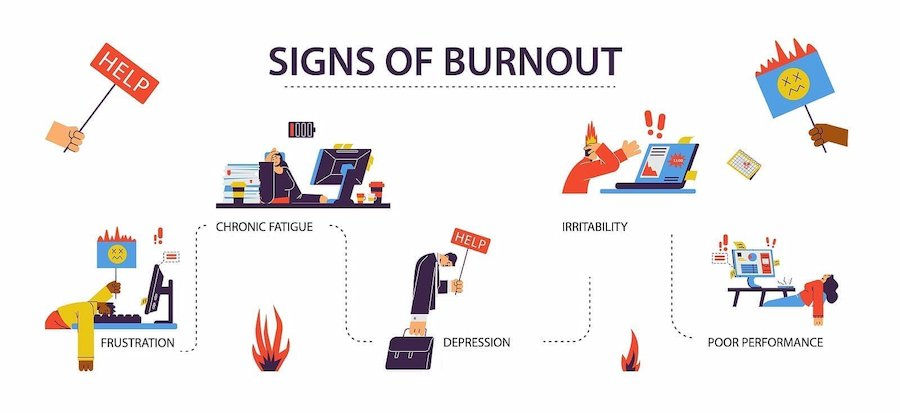
The popular understanding of burnout treats it as primarily psychological - a depletion of motivation, meaning, and emotional resources from prolonged work stress.
This is accurate but incomplete. Burnout has a clear physiological dimension that most burnout articles ignore entirely.
Chronic work stress produces sustained cortisol elevation. Over weeks and months, this disrupts the HPA axis - the hormonal system that regulates the stress response. The result is a nervous system that has lost its normal capacity to regulate between alert and rest states. You can't fully activate when you need to perform and you can't fully deactivate when you need to recover.
This is why burnout doesn't resolve with a week off. The hormonal dysregulation doesn't reset in seven days. The nervous system needs a sustained reduction in total load - not just work load - to recalibrate.
What overtraining actually is
Overtraining is what happens when training stimulus consistently exceeds recovery capacity over time.
The common image of overtraining is someone doing two-a-days and ignoring injury signals. For software engineers, the reality is more subtle and more common than that image suggests.
A developer training three times a week at moderate intensity, sleeping six hours a night, managing a high-pressure sprint, dealing with a difficult performance review cycle, and carrying the general cognitive load of a senior technical role is not doing three moderate sessions per week. They are doing three moderate sessions on top of a system already running near capacity.
The training load hasn't changed. The total load has. And the body responds to total load.
Overtraining in this population rarely looks like an athlete who has destroyed themselves in the gym. It looks like someone who trains consistently but stops making progress. Who feels heavier and slower despite no change in program. Who gets minor injuries that don't quite heal. Whose gym sessions feel harder than the numbers suggest they should. Whose HRV trends down over weeks despite adequate sleep duration.
The diagnostic question that separates them
There is one question that points more reliably toward the correct diagnosis than any symptom checklist.
When did the exhaustion start relative to your training?
If the exhaustion preceded or was unrelated to your training - if you felt this way before you started training hard, or during periods when you weren't training at all - the primary driver is likely work stress and burnout.
If the exhaustion correlates with periods of increased training load, or if you felt significantly better during a forced training break, overtraining is likely contributing.
The honest answer is usually both. Software engineers who burn out at work frequently increase training intensity simultaneously - using the gym as stress relief, pushing harder because it's the one domain they feel control over. The work stress suppresses recovery. The training adds load to an already compromised system. Both conditions develop in parallel and reinforce each other.
I track my own recovery with a Whoop. The pattern is consistent - during high work stress periods, my recovery scores drop even when training volume is unchanged and sleep duration is adequate. The body is processing something. The training is the same. The total load is not.
Why getting the diagnosis wrong is costly
If you have burnout and treat it as overtraining - taking time off training, reducing gym frequency, prioritizing rest - you may feel somewhat better physically but the work stress driving the hormonal dysregulation remains unaddressed. The improvement is partial and temporary.
If you have overtraining contributing to burnout and treat it as pure burnout - taking a week off work, trying to rest more, maybe starting therapy - you return to training at the same volume on a system that hasn't recovered from it. The exhaustion persists. You conclude that rest doesn't work and push through instead.
The correct response to the combined presentation - which is the most common presentation in this population - requires reducing total load simultaneously across both domains. Less training volume for four to six weeks. Genuine reduction in work intensity where possible. Sleep as a primary target, not a secondary consideration.
This is the intervention that most burnout frameworks miss because they treat the body and the work as separate systems. They are not separate. They share the same recovery pool.
What recovery actually looks like
Recovery from the combined burnout-overtraining presentation is not passive. It is not simply doing less and waiting.
The first change is training volume, not training frequency. Keeping two sessions per week but reducing intensity and volume significantly - fewer sets, lower weights, same movement patterns. Stopping training entirely removes one of the few reliable mechanisms for cortisol regulation available without a prescription. Maintaining it at reduced load keeps the benefit while removing the additional stress.
The second change is sleep architecture, not just sleep duration. Six hours of quality sleep with low overnight stress produces better recovery than eight hours of fragmented sleep with elevated cortisol. The wind-down protocol - no screens in the final hour, no unresolved work problems before bed, physical movement earlier in the day - matters more than adding time in bed.
The third change is the end-of-day transition. The open loops in working memory that keep the nervous system in a low-level alert state through the evening need to be externalized - written down, captured somewhere outside the brain - before the system can begin genuine recovery. This is not journaling. It is cache management. The brain needs to know the problems are stored before it releases them.
The fourth is patience with a timeline that feels too long. The HPA axis dysregulation that underlies both burnout and overtraining takes eight to twelve weeks of reduced total load to meaningfully recalibrate. Engineers who feel somewhat better after two weeks and return to full intensity at work and in the gym are not recovered. They are in the early phase of recovery and have just reset the clock.
The signal worth paying attention to
If you are a software engineer who trains, the most reliable early warning signal for both conditions is a sustained downward trend in HRV over two to three weeks accompanied by subjective fatigue that doesn't match your training load.
Not one bad night. Not one low recovery score. A trend.
HRV doesn't lie the way perceived effort sometimes does. High performers are extraordinarily good at overriding physical signals with professional identity and willpower. The data bypasses that override.
The engineer who catches the trend early - who reduces total load before the system fully breaks - recovers in weeks rather than months. The one who pushes through until the breakdown is forced recovers on the timeline described above, often after an illness or injury that makes the choice for them.
The body gives warnings before it gives ultimatums. Learning to read them is one of the highest-leverage investments a software engineer can make in their long-term performance.
I work 1:1 with software engineers and tech professionals on building training and recovery systems that account for the actual demands of the career - including the weeks when everything is too much. Book a free 30-minute call and let's talk about what's actually going on.

Frequently asked questions
Is burnout the same as overtraining? No, but they share almost identical symptoms because both represent a nervous system under more cumulative load than it can recover from. The source differs - one is primarily work stress, the other is training stress - but the physiological experience overlaps significantly. Most software engineers who train are dealing with both simultaneously.
How do I know if I have burnout or overtraining? The most reliable diagnostic question is timing. Did the exhaustion start before or independently of your training? If yes, burnout is the primary driver. If exhaustion correlates with increased training load or improved during a forced training break, overtraining is likely contributing. HRV data tracked over two to three weeks gives a more objective picture than symptoms alone.
Can you train through burnout? Not at full intensity. Stopping training entirely removes one of the few reliable mechanisms for cortisol regulation, which makes burnout worse. The correct approach is maintaining two sessions per week at significantly reduced volume and intensity - enough to keep the physiological benefit without adding to total load.
How long does recovery take? The HPA axis dysregulation underlying both conditions takes eight to twelve weeks of genuinely reduced total load to meaningfully recalibrate. Engineers who return to full intensity after two weeks of feeling better are in early recovery, not full recovery.
Why do software engineers get overtraining symptoms even with moderate training volume? Because the body doesn't distinguish between sources of stress. Three moderate gym sessions per week on top of a high-pressure sprint, poor sleep, and the chronic cognitive load of a senior technical role is not three moderate sessions. It is three moderate sessions on an already compromised system. Total load is what matters, not training load in isolation.
What is HRV and why does it matter for this? Heart rate variability measures the variation in time between heartbeats and reflects the state of the autonomic nervous system. High HRV indicates good recovery capacity. Low HRV indicates accumulated load. It responds to total stress - work, training, sleep, emotional demands - making it the most useful single metric for understanding whether your system is genuinely recovered or running on fumes.


Comments